

Submit a Proposal for the 11th Annual FLCHE Conference
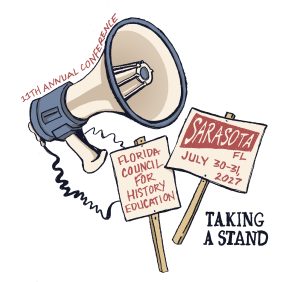
The Florida Council for History Education (FLCHE) is pleased to announce a call for proposals for our 11th Annual Conference, to be held July 30–31, 2027, in Sarasota, Florida.
FLCHE welcomes proposals from classroom educators, historians, museum and archival professionals, scholars, public historians, educational organizations, and others committed to meaningful history education. While all history-focused submissions are welcome, we particularly encourage presentations that connect to our conference theme:
Taking a Stand
Aligned with the National History Day® 2028 annual theme, Taking a Stand invites educators to explore the individuals, groups, movements, organizations, and institutions that chose to act when confronted with an issue, challenge, injustice, belief, or opportunity for change.
Understanding the Theme:
What does it mean to take a stand?
Taking a stand involves more than simply holding an opinion. It requires a person or group to take a position and act upon it. Throughout history, people have taken stands for ideas they believed should be advanced and against policies, practices, institutions, traditions, or prevailing ideas they sought to challenge.
A stand might be political, social, economic, intellectual, cultural, religious, military, scientific, or artistic. It might involve public protest, political action, court challenges, writing and publishing, artistic expression, scientific discovery, economic pressure, military resistance, community organizing, or quieter forms of individual courage.
Those who take a stand may succeed, fail, compromise, inspire others, face opposition, or produce consequences they never anticipated. Some stands create immediate change; others have effects that are not fully understood until decades later.
When considering a proposal connected to the conference theme, presenters might explore questions such as:
- What historical circumstances created the need or opportunity for someone to take a stand?
- Who took the stand, and what motivated them?
- What issue, belief, policy, practice, or institution were they supporting or challenging?
- What actions transformed a belief or position into a historical stand?
- What risks, resistance, or opposition did they encounter?
- Who supported the stand, and who opposed it? Why?
- What were the immediate consequences of the stand?
- What changed—or did not change—as a result?
- Did an unsuccessful stand eventually influence later people, movements, or events?
- What was the stand's long-term historical significance or legacy?
- How can primary sources help students understand the perspectives of those who took a stand as well as those who opposed them?
The theme is intentionally broad. Presentations may examine well-known historical figures and movements, but we also encourage presenters to look beyond familiar narratives to uncover local stories, lesser-known individuals, community movements, overlooked perspectives, and unexpected examples of people taking a stand.
Proposal Ideas:
Conference proposals might include, but are certainly not limited to:
- Historical case studies connected to Taking a Stand
- Florida or local history stories that illuminate the conference theme
- Primary-source collections and strategies for teaching historical perspectives
- Lessons that help students distinguish between holding an opinion and taking meaningful historical action
- Approaches to teaching resistance, protest, advocacy, reform, dissent, and civic action in historical context
- Strategies for examining competing perspectives surrounding a historical stand
- Lessons exploring the consequences, successes, failures, or unintended outcomes of historical actions
- National History Day® strategies, resources, and classroom applications
- Disciplinary literacy and historical thinking strategies
- Inquiry-based approaches to teaching complex or contested historical topics
- Museum, archive, historic site, and public-history resources for educators
- Innovative practices that strengthen students' historical research, analysis, and argumentation
Session Formats:
Breakout Sessions are 45 minutes and should engage attendees through informative content, visuals, primary sources, teaching strategies, discussion, or other interactive elements. Sessions should contribute to building historical content knowledge while promoting history education and disciplinary literacy.
Poster Sessions provide presenters an opportunity to engage with attendees in smaller groups during two 20-minute presentation blocks. Poster sessions should include a visual display and may incorporate optional technology. Posters typically combine text, photographs, primary sources, maps, tables, graphs, research findings, instructional resources, or other visuals. Presenters may also use a laptop or other technology to share videos, digital collections, websites, lesson materials, or additional resources.
FLCHE especially values sessions that leave participants with historical content, primary sources, instructional resources, or practical strategies they can bring back to their classrooms and educational communities.
We invite you to join educators and historians from across Florida as we explore the people, choices, actions, consequences, and legacies that demonstrate what it means to Take a Stand.

To be considered as a presenter, submit your proposal by April 23, 2027. Presenters will receive notification via email by May 11, 2027.
Please note: Those selected to present at the 2027 FLCHE Conference are required to register and pay for the conference, no later than May 31, 2027.
Florida Council for History Education (FLCHE) is pleased to present our 7th annual conference at historic Flagler College in St. Augustine, Florida. Please join us as we share our organization’s mission to promote history in education as a way to appreciate the progress and awareness of past and present events. Conference presentations will reflect the theme, Turning Points in History. All sessions will focus on building content knowledge, promoting history education and disciplinary literacy, and the use of primary sources.